We're in this together.

"Every old person knows what it is to be young.
But no young person can know what it is to be old."

If you're 65+, you may not know this — but whatever your age — you can gain strength, mobility and independence through resistance training. And I can help you do that.

In 2024, at age 78, I fell flat on my face in a parking lot, and it changed me. I learned that we get weaker as we age, but most importantly, that we can do something about it! I also realized that the exercise routine I'd been following for years was not a good choice for someone my age. Luckily, I found a fitness program called the Functional Aging Training Model. And as a result I launched a new career as a personal trainer, working exclusively with people 65+.

In December 2025 I became a Certified Personal Trainer and Certified Functional Aging Specialist. Now I'm helping people my age be strong, mobile, and independent.

The Silent Thief — Sarcopenia

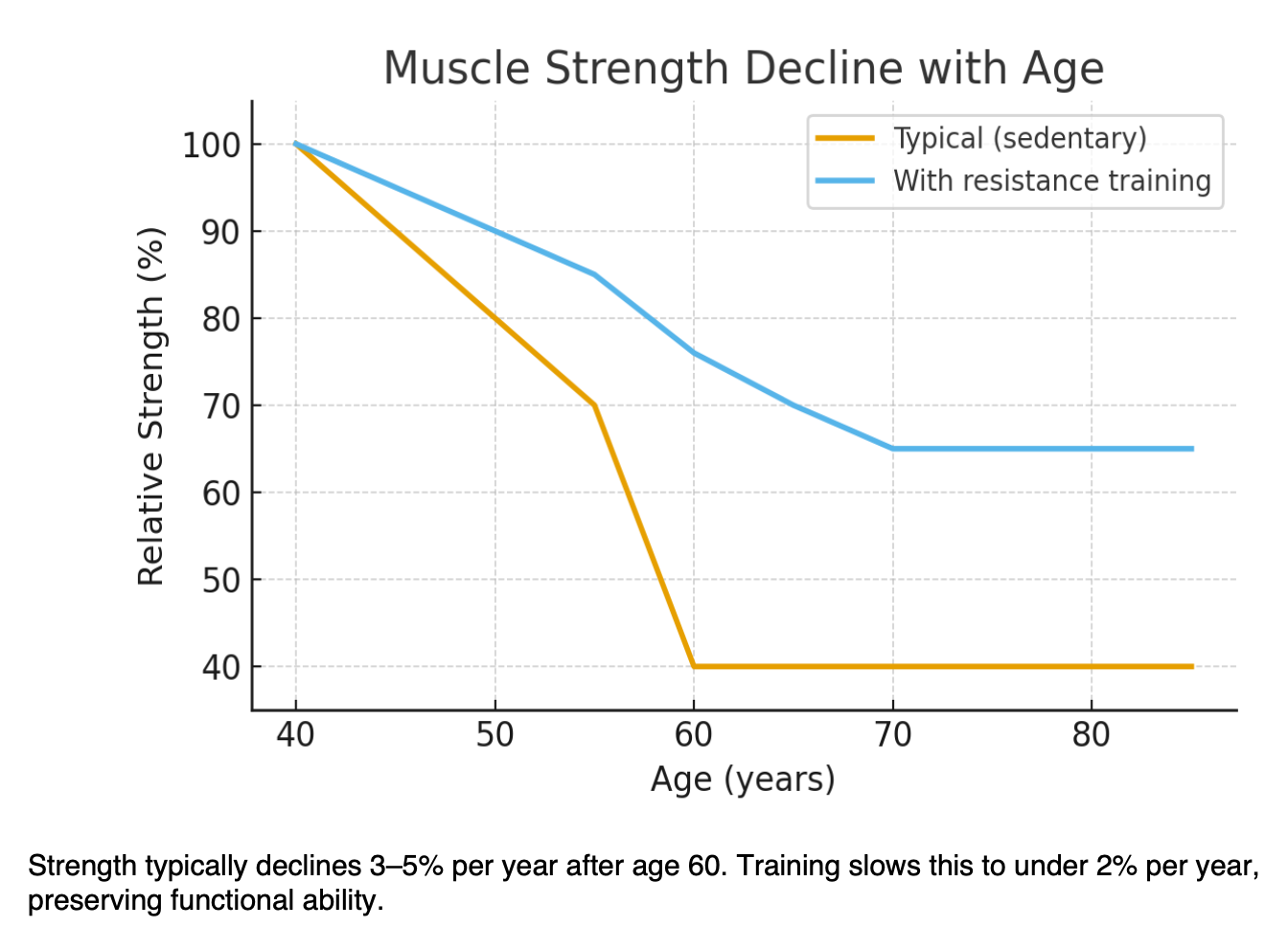
Most adults have never heard of sarcopenia, but as we age it's been in the background, quietly stealing our strength, mobility, and independence. It begins in our 40s and accelerates dramatically after we turn 60.

The research is clear: adults of all ages can build meaningful strength with a consistent program of resistance training and progressive overloading.
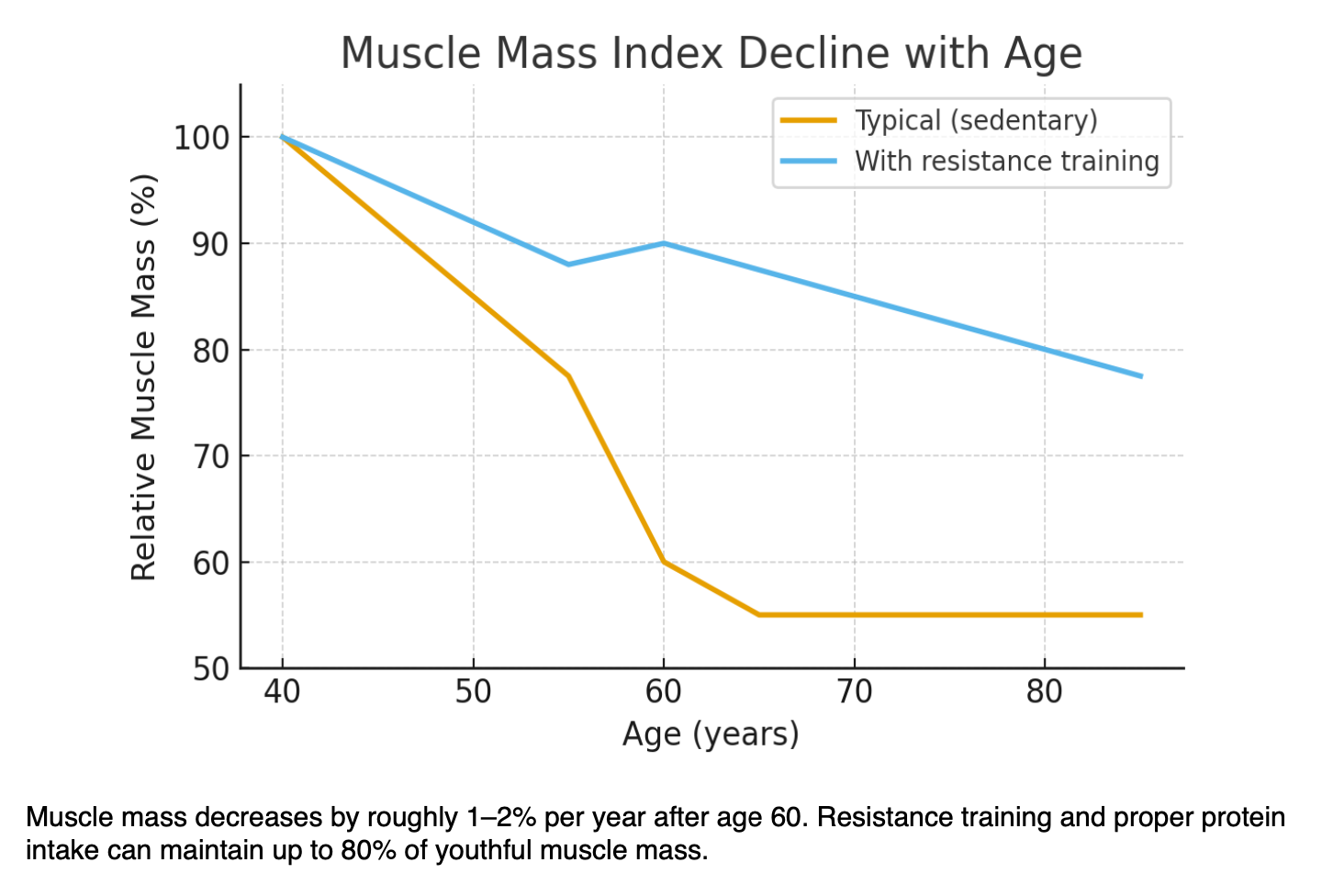
Chart: relative muscle mass declines with age, with resistance training preserving much more than a sedentary path
Chart: relative muscle strength declines with age, with resistance training preserving much more than a sedentary path

The proven method for slowing and restoring muscle mass lost due to sarcopenia is resistance training. Our muscles grow when they are working against something — a free weight, a stretch band, or the weight of our own body. Less muscle means less independence. The good news is that muscle responds to training at any age. People like us in their 70s, 80s, and 90s build real strength when we train consistently.

Progressive overloading is the key. As we exercise our bodies gradually adapt and eventually we plateau, a sort of neutral. We don't get stronger or weaker. To keep getting stronger, we must gradually ask a little more of our muscles — one more repetition, an extra set, a slightly heavier weight. Small, steady steps, and our bodies will respond.

The Functional Aging
Training ModelTM

The model was built specifically to counter the effects of Sarcopenia and comes from the Functional Aging Institute, created by Dr. Dan Ritchie and Dr. Cody Sipe. It establishes a standardized approach to strength training for seniors.

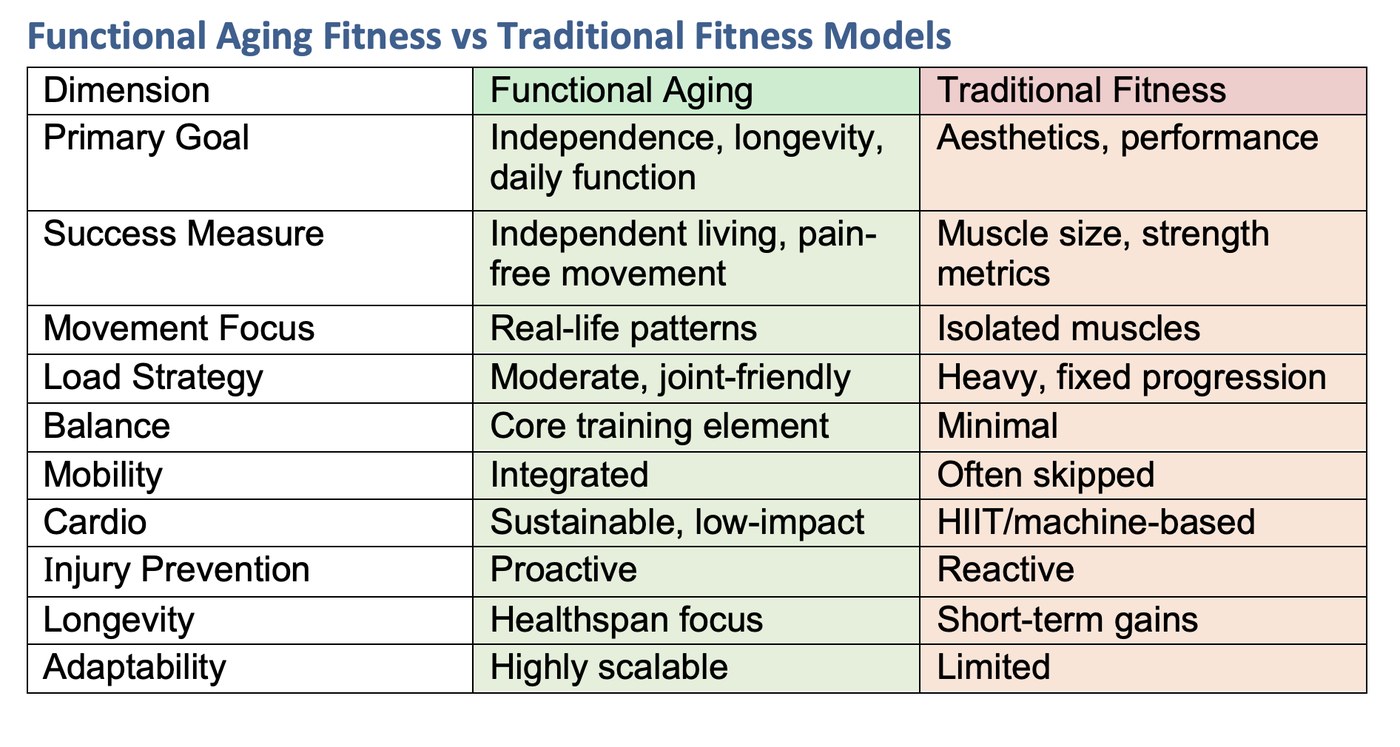
The key difference between the FATM and other training approaches is that the focus is on the muscles we use in our everyday lives — to function. To get up from a chair, to carry groceries, to climb stairs, to prevent falls.

This is how it works.

We start with where you are now
Every program starts with a thorough individual assessment, including health and exercise history, and identifying your current capabilities and constraints.
Your specific goals
People 65+ have very different goals from people in their 40s. Together, after the assessment, we set goals that are important to you and the life that you live. That will help keep you motivated and engaged and lead directly to success.
Train for real life
Getting up from a chair, preventing falls, living independently, mobility that lets you continue doing the activities you love. The metrics we'll use to plan your exercise program come directly from the goals we've set.
Progressive overload
Building strength is a process, and over time we'll gradually increase the load or stress placed on your muscles. We do this by adjusting: the amount of weight you're lifting, the number of repetitions you do for each activity, how long you work out, and by shortening your rests between sets and reps.
Safety is non-negotiable
For adults 65+ an injury can be disastrous. If someone 35 injures themselves during training, recovery can be brief. But for people 65+ injuries can be much more challenging. That's why the FATM embeds safety into every exercise strategy, every individual routine, every session.
Re-assess and adjust
Achieving your goals is why you're doing this and knowing where you are in relation to those goals tells us whether we're on the right track. On a regular basis we'll reassess your progress and adjust your program as needed. We use quantitative and qualitative metrics — everything from the number of exercise repetitions and weights used — to how quickly you can get up out of a chair without using your arms.

If you do nothing else, do this!

Make a promise to yourself that you'll start gaining strength by doing a single exercise — today. You can do it at home. No equipment required.

It's a variation of a SQUAT, called sit-to-stand. Overall, one of the single best exercises ever! Its purpose is to build strength in our core, the central muscle system in our bodies that helps us stand up, turn, lift, push.

For seniors, learning to do squats can be wobbly. In this video I'm demonstrating using a TRX strap that I hold very lightly. It gives clients a secure base. At home you can use a chair, a kitchen counter, anything solid.

Squat with support

After your body becomes comfortable doing squats, transition to sit-to-stand. Begin sitting on a low bench or chair. This provides a safety mechanism, if you get tired or wobbly, you just sit down.

Cross your arms and stand up. Initially it may be difficult and if it helps, put the chair next to your kitchen counter, stabilize yourself by holding lightly to the counter with one hand. If you're in a gym, use a bench press seat and use the frame as support. Then stand up.

You'll get stronger and eventually be hands-free. Start slowly. Do 5 to 10 repetitions every other day for a couple weeks. Then add two or three repetitions, gradually increase. In a month or so you'll be able to see real progress.

Sit-to-stand

When you can consistently do a sit-to-stand (somewhere around 2 sets of 25 repetitions, 2-3 times a week), transition to adding weight by holding a dumbbell in your arms. This is called progressive overloading.

Start small, holding 3-5 pounds. Every few weeks, add 5 pounds. If you feel tired, drop back to the previous weight.

As you progress, you may want to shift from adding weight to adding another set. You may notice in the video that I stand up quickly and sit down slowly. It's a way to add power to the movement and can be done with almost any resistance exercise.

Adding weight

Questions you might be asking.

Most of these came from real conversations — with friends, neighbors, and people my age who were thinking about getting started but were hesitant. Or who started and quit.

Is it safe for me to start exercising at my age, especially if I haven't worked out in years?

For the vast majority of people 65+, the answer is yes — research is unambiguous that the risk of not exercising is far greater than the risk of starting. We'll begin with a careful assessment, work at a pace that respects your body, and build up only as you're ready.

Do I need clearance from my doctor before we start?

If you have any cardiovascular condition, are recovering from surgery, or have a chronic condition your doctor is actively managing, the answer is yes. For most other situations, a conversation with your doctor is a good idea but not required. I'll ask you a thorough health-history questionnaire either way.

What are your qualifications?

I'm an ISSA Certified Personal Trainer and an ISSA Certified Functional Aging Specialist — that second certification specifically covers the science and methods of training adults 65 and older. I'm not a physical therapist, and I'm not a doctor — I'm a trainer who specializes in our age group, an 80-year-old male who wants to live the rest of my life strong, mobile, and independent.

Have you actually worked with people my age?

Yes. I started by working with friends in my own circle — people I trusted to give me honest feedback and tell me when something wasn't working. That's how I built my approach: real reps with real people in their 70s and 80s, not theory.

How is training someone my age different from training a younger person?

Younger trainers typically focus on aesthetics, performance, and PRs. Clients 65+ have different goals: keeping out of assisted living, making the stairs feel easy again, getting up off the floor without thinking about it, staying steady on uneven ground. The exercises are adapted, the rest periods are different, the sequencing is different, and progression is much more gradual. I built my training approach around those differences.

Will you push me too hard? Or not hard enough?

This is a question I think about a lot. In my personal training over the years I regularly pushed myself. But in the last few years I've learned that approach isn't necessary and it's easy to get injured. I've also learned the importance of recovery time for people 65+. I'll push you a little — strength gains require progressive effort — but always while watching how your body is responding. We'll talk constantly during sessions. If something doesn't feel right, we change it. Period.

What does a typical session involve? Will I be lifting weights?

A typical session runs about an hour: a warm-up, then strength work (sometimes including weights, but mostly body weight), balance training, mobility, and a cool-down. Living involves pushing, pulling, lifting, and turning — and that's how we'll work together.

Do I need to be able to get down on the floor?

Maybe. Getting up and down from the floor safely is an important skill for staying independent, so we'll likely work toward that over time, at your pace. If you can't do it now, we use chairs, benches, and standing variations. If you can, we'll help you maintain that capability.

How often should we meet, and where?

For most clients, twice a week is the sweet spot — enough frequency to build real strength, enough recovery between sessions. Some clients do well with once a week plus homework.

As for where: we can work at a gym — either one you currently go to or one I suggest you join — in your home, or virtually over video (you at home, me in a gym). I can physically go pretty much anywhere in northern Manhattan (New York City), the Bronx, and Westchester County. We'll figure out what fits your situation.

I'm worried about losing my independence. Can training really help?

This is the central question, and the answer is yes — more than almost anything else available to you. The single biggest predictor of whether someone stays in their own home as they age is whether they can stand up from a chair without help. Strength is what protects independence. That's why I started 65PlusFitness.

What if I have a bad day and can't do much?

That's reality for all of us. We'll adjust. Some days you'll show up tired, sore, or distracted, and we'll slow things down or try something new. Some days you'll surprise yourself. Both kinds of days are part of the process.

What does it cost?

Sessions run $75–$100 per hour, depending on location and frequency. Packages can bring the per-session rate down. The first conversation is free. We'll talk about your situation and figure out whether this makes sense for you.

I'm embarrassed about my current fitness level. Is that going to be a problem?

No. In the fall of 2024, I was 78 years old when I fell flat on my face crossing a parking lot. I was in OK shape and very lucky not to break my nose or get a concussion. It was shocking — and embarrassing — that it had happened at all. I stopped training for a while, did a reset, found a trainer, and discovered Functional Aging Training. And now, because I know exactly how it feels to realize what being this age means, I started 65PlusFitness. Wherever you're starting is fine.

I've tried gyms before and felt out of place. How is this different?

Most gyms are designed for people in their 20s, 30s, and 40s, and staffed by trainers who've never lived in a 70- or 80-year-old body. The room can be noisy, the equipment intimidating, and the culture built around looking a certain way. 65PlusFitness is the opposite of that. If we work in a public gym, we'll still be focused, individualized, and engaged in the things that actually matter at our age. You won't feel out of place. You'll feel like the work was tailor-made for you — because it was.

Ready to get
stronger?

The first conversation is free. No commitment. Just a chance to talk about where you are, what's getting harder, and whether 65PlusFitness might be the right fit for you.

Phone (845) 943-0623
Email Jim@65PlusFitness.com

Book a Free Call

"I'm 80 years old and I know what it feels like to be afraid of falling. And I know what it's like to want to stop exercising. I also know that you can get stronger. I did and so can you."

— Jim Decker, Certified Functional Aging Specialist